
Bench Calculators
This is the manual. Bench Calculators runs in your browser, free, no account.
Open Bench CalculatorsTry it on the PCR, multiplex & fusion sampleOverviewSolve a dilution for its one missing quantity, plan a serial dilution, convert a molecule's mass to moles, and scale a vendor's reaction setup into a master mix.
| Reached by | Tools → Bench Calculators |
| Sample project | PCR test |
What it does
The arithmetic that comes before almost every experiment, in one panel with four tabs.
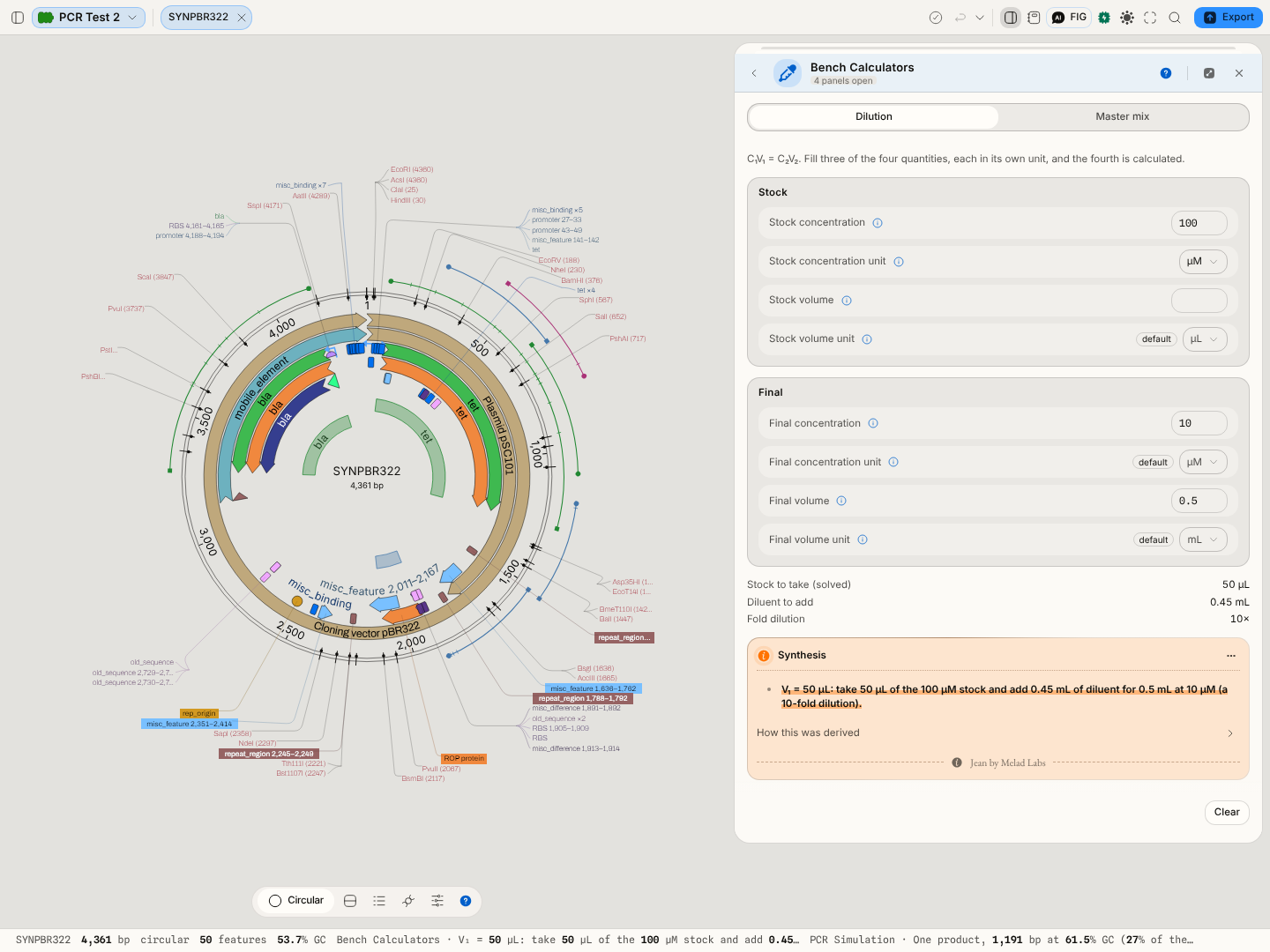
Dilution. Fill three of stock concentration, stock volume, final concentration and final volume, each in whatever unit you work in, and the fourth is calculated in the unit you chose for it. The answer comes with the fold dilution and the volume of diluent to add to the stock.
Serial dilution. The same dilution repeated tube after tube, for a standard curve, a titration or a plating series. Give the stock, the fold at each step (1
is 10), how many tubes, and the volume each tube should hold after mixing. Every tube gets the same diluent and the same transfer from the tube before, so the concentration after n steps is the stock divided by the fold n times. The table lists each tube's dilution and concentration, and what it still holds once it has given its transfer to the next tube (the last tube keeps all of it).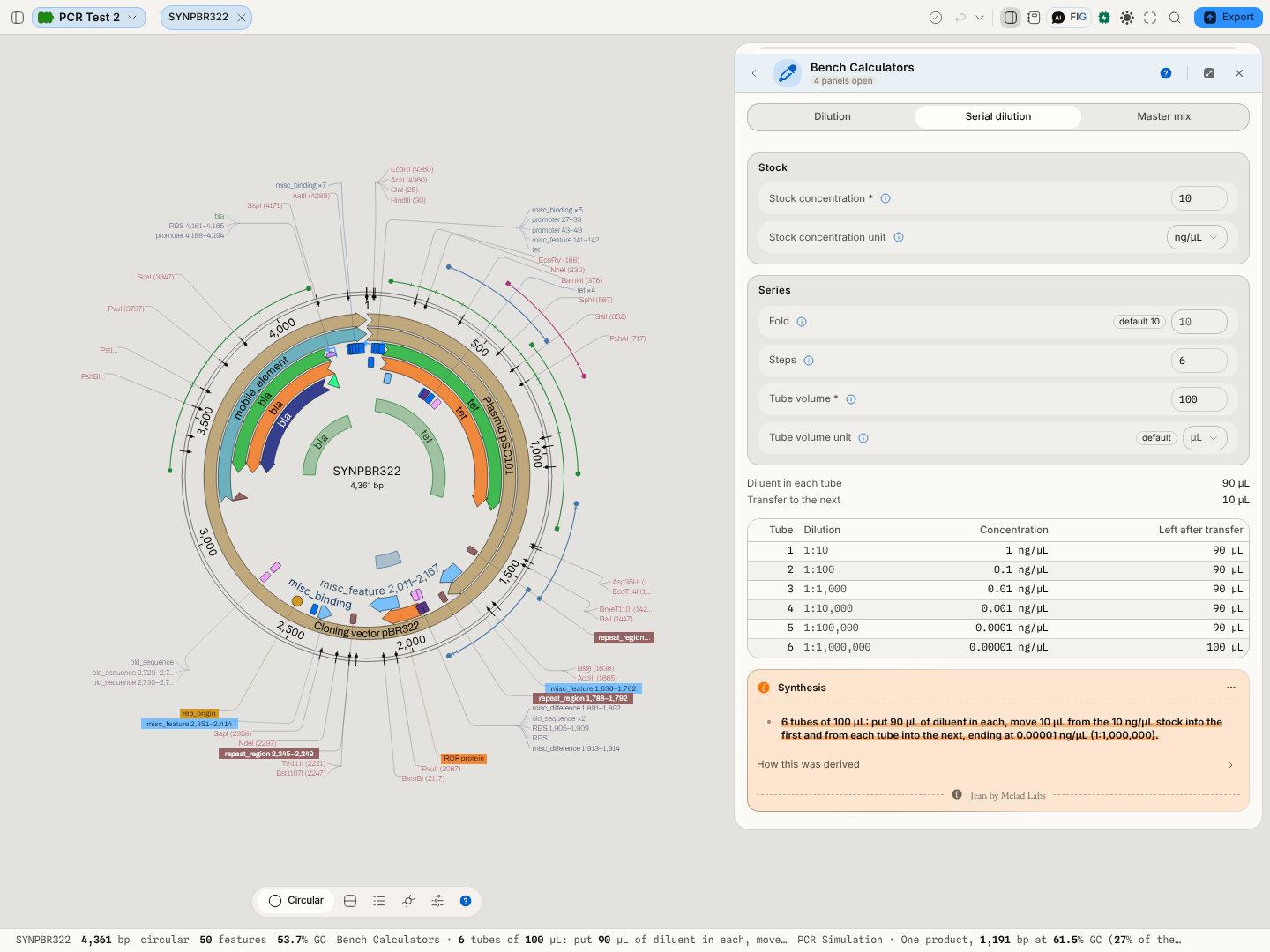
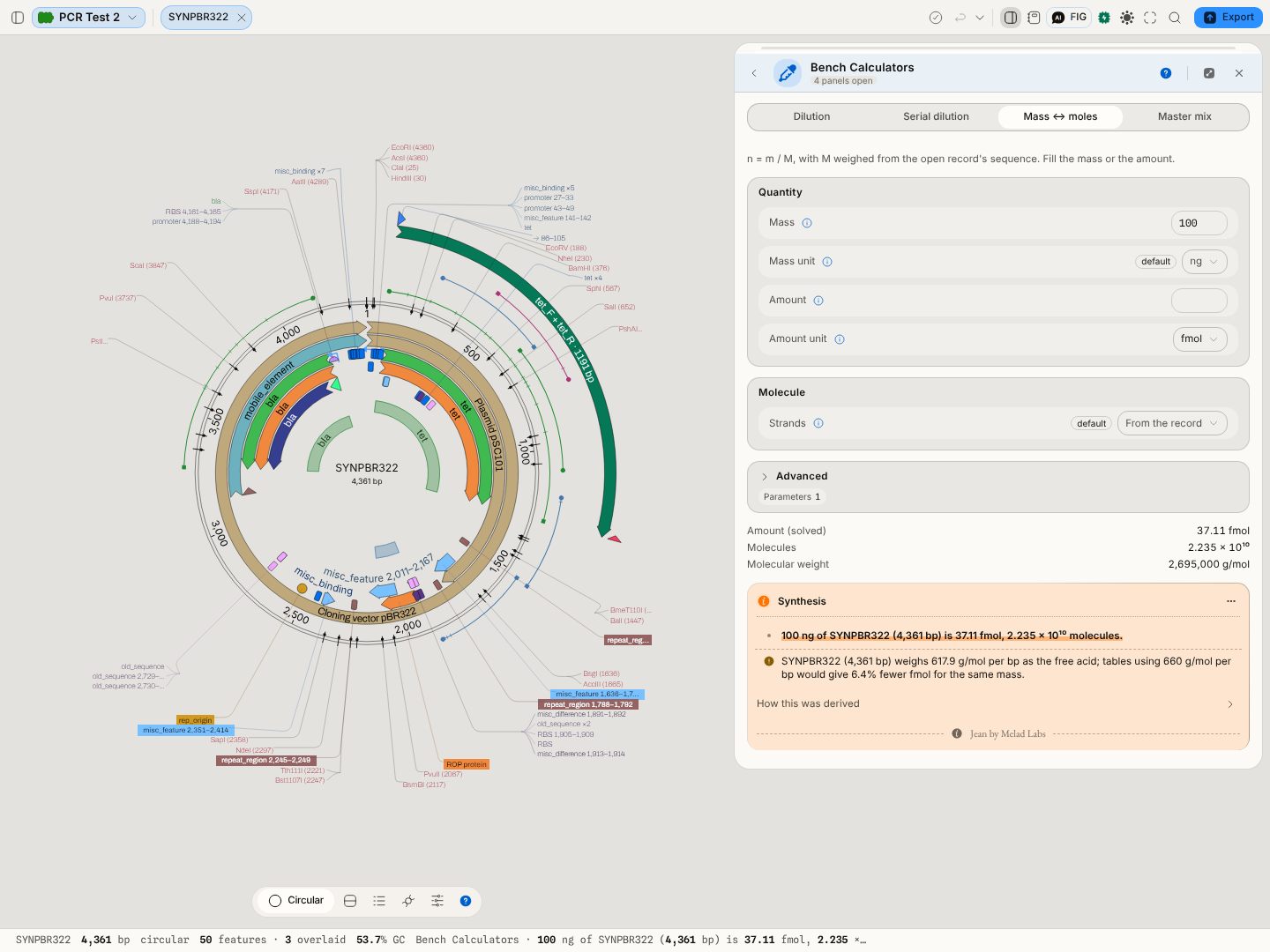
Mass ↔ moles. How many picomoles, or how many copies, is 100 ng of the plasmid you have open? Give the mass and the amount is calculated, or the amount and the mass is. The molecular weight is the open record's own, computed from its sequence: both strands of a DNA molecule, under its own topology, or the one strand of an RNA. Choose One strand for an oligo, or type a weight for a molecule that is not open.
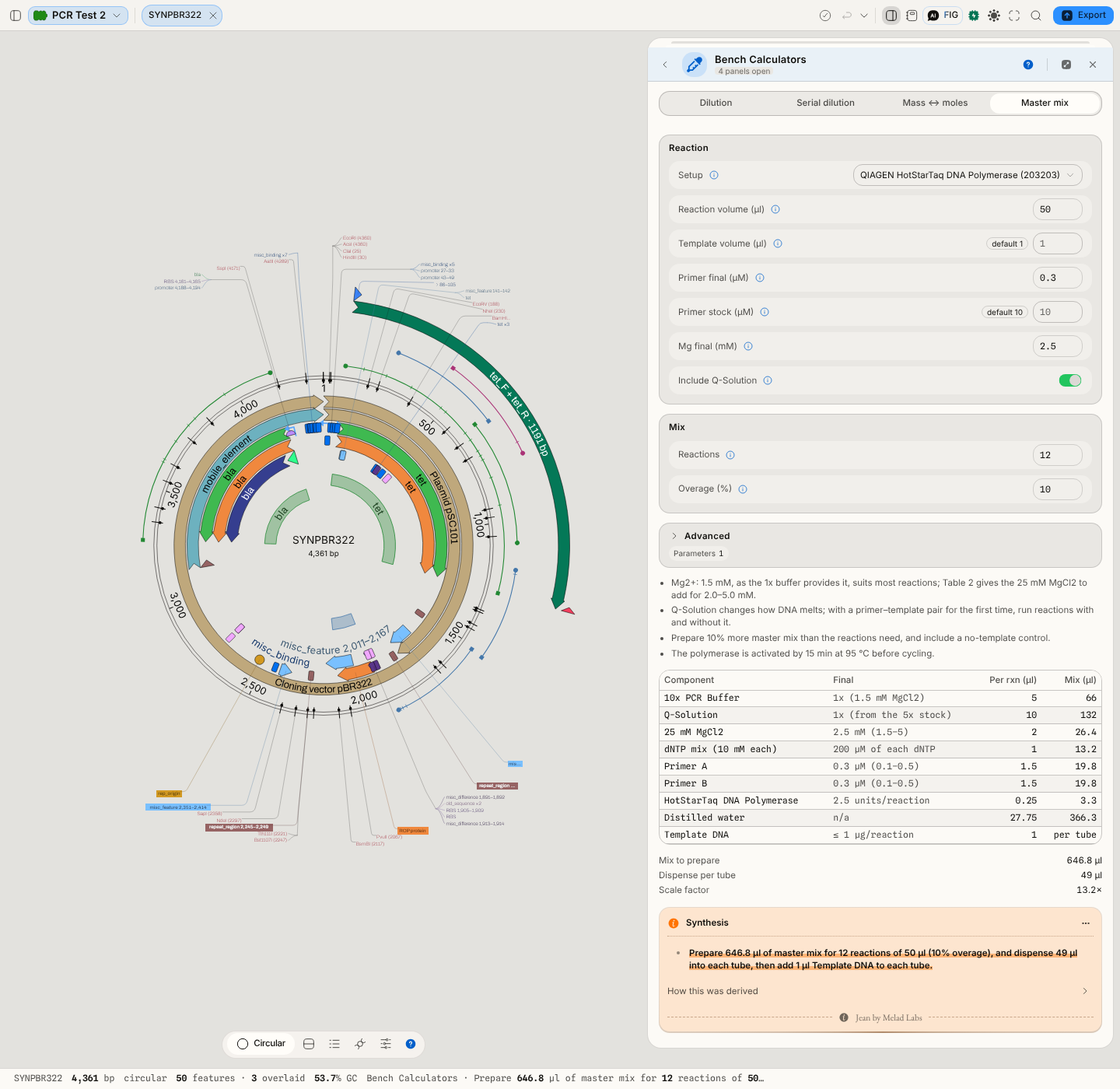
Master mix. Pick a polymerase's published reaction setup, the reaction volume and the number of reactions. Every component is scaled with the vendor's final concentrations kept, water makes up the volume, and the template is added to each tube rather than to the mix. Add overage for pipetting loss, or replace the vendor setup with your own recipe.
Most vendors do not give the primers a volume. They give a final concentration, often a range (0.2–1.0 µM), because the volume depends on how concentrated your primer stock is. The panel asks for that stock and the concentration you want, and works the volume out the same way the Dilution tab would. QIAGEN does the same for magnesium: its buffer already brings 1.5 mM, and you add 25 mM MgCl₂ only to go higher. If you have set a polymerase in Settings · Lab, the Master mix tab opens on that polymerase's setup and says so.
Try it
- Open the PCR test sample project and choose Tools → Bench Calculators, then Master mix.
- Set Setup to QIAGEN HotStarTaq, Reaction volume to 50, Reactions to 12 and Overage to 10.
- Set Primer final to 0.3 and Mg final to 2.5, and switch on Include Q-Solution.
- The panel asks for 646.8 µl of mix: 49 µl into each tube, then 1 µl of template. Each primer is 1.5 µl of the 10 µM stock, and the MgCl₂ is 2 µl, half of what the handbook's Table 2 gives for a 100 µl reaction.
- Set Primer final to 0.8. The plan still works out, and it now warns that 0.8 µM is outside the 0.1–0.5 µM QIAGEN recommends.
What this computes
- Solved quantity: C₁V₁ = C₂V₂ for the one quantity left empty, from molar (M to fM), mass per volume (mg/mL to ng/mL), fold (X) or percent concentrations, and volumes from litres to nanolitres.
- Fold dilution: C₁/C₂.
- Serial dilution transfer and diluent: C₁V₁ = C₂V₂ for one step of the series, transfer = tube volume / fold and diluent = tube volume − transfer, the same in every tube.
- Series concentrations: the stock divided by foldⁿ for tube n, with the cumulative dilution (1) and the volume each tube keeps after its transfer.
- Diluent volume: V₂ − V₁, in the final volume's unit.
- Scaled reaction setup: each component's volume per reaction at the chosen reaction volume, in proportion to the vendor's published columns, with the vendor's final concentration beside it.
- Amount from mass (and mass from amount): n = m / M, with M the open record's molecular weight from its sequence or one you type.
- Molecules: the amount × the Avogadro constant (6.02214076 × 10²³ per mole, exact).
- Per-base-pair weight check: for a double-stranded record, its weight per base pair and how far a 660 g/mol per base pair rule of thumb would move the answer.
- Dosed component volume: for a primer or magnesium the vendor gives as a concentration, C₁V₁ = C₂V₂ with your stock as C₁ and the reaction volume as V₂. For magnesium, C₂ is the total you ask for less what the buffer already contains.
- Out-of-range warning: a primer or magnesium concentration outside the range the vendor states, naming the component and the range.
- Water to volume: the reaction volume less every other component.
- Master mix volumes: each shared component × reactions × (1 + overage).
- Dispense per tube and mix to prepare.
When you'd use this
- Diluting a 100 µM primer stock to a 10 µM working stock, or a plasmid prep to a loading concentration.
- Making a tenfold standard series for a qPCR standard curve, or a twofold series for a titration.
- Working out how many copies of a plasmid are in a qPCR standard, or the picomoles of vector for a ligation.
- Setting up a plate of PCRs without writing the recipe out by hand.
- Scaling NEB's 20 µl or 50 µl Phusion setup to a 25 µl reaction.
- Turning a Takara datasheet's "10–15 pmol per 50 µl" into microlitres of your own primer stock.
Tips
- Leave Primer final empty to use the vendor's own value: a single stated concentration where there is one, otherwise the low end of the range. The derivation says which it used.
- The primer volume scales with your stock, not with the vendor's. A 5 µM stock needs twice the volume of a 10 µM one for the same final concentration, and a stock weaker than the final concentration you ask for is refused.
- Raise magnesium in small steps. QIAGEN's own advice is that the 1.5 mM in the buffer suits most reactions.
Controls
| Control | What it does |
|---|---|
| C₁, V₁, C₂, V₂ and their units | Leave exactly one empty; it is solved. |
| Stock, fold, steps, tube volume | The serial dilution: what it starts from, the dilution at each step, how many tubes, and each tube's volume after mixing. A larger fold shrinks the transfer; a larger volume scales both the transfer and the diluent. |
| Mass, amount and their units | Leave one empty; it is calculated in the unit you chose. |
| Strands | Which strands of the open record are weighed: from the record (both for DNA, one for RNA), both, or one. One strand halves the weight and doubles the moles. |
| Molecular weight | A weight to use instead of the open record's (under Advanced). |
| Reaction setup | The vendor setup to scale. |
| Reaction volume | Volume of one reaction. |
| Template volume | Template per reaction, added to each tube (the vendor leaves it to you). |
| Primer final | Final concentration of each primer. Raising it raises both primer volumes and lowers the water. Shown for setups that state primers as a concentration. |
| Primer stock | The concentration of your primer stock (10 µM unless you change it). Halving it doubles the primer volumes. |
| Mg final | Total magnesium for QIAGEN's setups. Each 0.5 mM above the buffer's 1.5 mM adds 1 µl of 25 mM MgCl₂ per 50 µl. |
| Include DMSO | Adds Phusion's optional DMSO (3% final). |
| Include Q-Solution | Adds QIAGEN's Q-Solution (1x final), an additive that changes how DNA melts. QIAGEN advises running a new primer and template pair with and without it. |
| Reactions, overage | How many reactions the mix is for, plus extra as a percent of the mix. |
| Components | Your own recipe instead of a vendor setup. |
Limitations
- A dilution can only lower a concentration; asking for a higher one is refused rather than answered with a negative volume.
- Molar and mass concentrations cannot be mixed in one dilution: converting between them needs the molecule's molar mass.
- Volumes are assumed to add on mixing.
- A serial dilution's pipetting error compounds down the series; the plan does not model it.
- The molecular weight is the molecule as written, as the free acid: counter-ions and water are not weighed. Calculators that use an average 660 g/mol per base pair give several percent fewer moles, and the panel says by how much for the molecule you have open.
- The bundled setups are NEB Phusion; Takara Bio's TaKaRa Taq, Ex Taq, LA Taq and Ex Premier, PrimeSTAR GXL (standard and rapid protocols), HS, Max and LongSeq, CloneAmp HiFi, SpeedSTAR HS, Terra PCR Direct, Titanium Taq and Advantage HD; and QIAGEN's Taq and HotStarTaq. A custom recipe is not checked against any polymerase's requirements.
- Each setup is the vendor's document on the date it was read. A reformulated product is not seen until the setup is refreshed.
Provenance
The molecular weight uses the same residue masses Biopython uses, and agrees with Biopython's molecular weight for the same sequence. The 660 g/mol per base pair comparison is Promega's BioMath average.
The serial dilution follows the convention of Carolina Biological Supply's serial dilution guide (each dilution made to one final volume) and reproduces its worked example exactly: three 1
dilutions of 20 mL from a 0.1 M stock, 2 mL into 18 mL each, ending at 1 × 10⁻⁴ M.Every setup is the vendor's own published reaction setup: NEB's protocol for Phusion M0530 (cross-checked against the copy NEB published on protocols.io, and its 20 µl and 50 µl columns both come out of the same scaling), each Takara Bio product's datasheet, manual or Protocol-at-a-Glance, and QIAGEN's Taq and HotStarTaq PCR handbooks. The magnesium arithmetic reproduces every column of QIAGEN's Table 2, and each primer amount Takara quotes in pmol matches the concentration it states beside it.
Melting Temperature
Compute the melting temperature of an oligo under conditions you state, rather than under conditions a tool assumed.
Codon Optimization
Rewrite a coding sequence for expression in a chosen host while holding the constraints that matter: forbidden restriction sites, GC window, homopolymer limits, and the encoded protein.